top of page

In my creative practice; first: start by building the 'foundations' I don't need to know the exact design of the 'roof'.


- Even though I am unsure on where I want to take my creative practice, I can start thinking and researching the general direction. This will bring on ideas to advance my practice.

- I had two different directions I wanted to go in - Medical illustration and branding and packaging design. By researching them I found which one would be best for my creative practice. I started this research with no idea of where it would take me.

- I know I want to do the branding and packaging design idea. I now need to research the different types of products that would interest me to create a project around. To do this I can start talking to others who may have knowledge about packaging that I wasn't aware of.


Convergent VS Divergent Thinking


Convergent - Being Logical

- There is a 'correct' answer and 'right' or 'wrong'

- Focused on speed, accuracy and logic

- Reapplying already known techniques

- Accumulating stored information

- Single best answers with no room for ambiguity

- New combinations of old ideas - manipulating existing knowledge

- Most common tool


Divergent - Lateral Thinking

- Accepting many possible solutions

- Spontaneous, free flowing creative ideas which are generated and evaluated

- Multiple solutions explored

- Unexpected connections made

  • Brainstorming

  • Free Writing

  • Free form creative thinking

After the process of divergent thinking ideas and information are more organised and structured by convergent thinking.

To begin with my project was divergent thinking until I found the project I wanted to go with.


Evergent Logic

- Advanced version of divergent thinking - seen as a 'moving image' rather than a 'still photograph'.

- Emergence is giving up control. Learning from own footprintsduring the design thinking, planning and executing

  • don't hold too tightly to one idea

  • Embrace letting ideas and plans emerge out of themselves

  • Reflect on what you're doing to grow the design project


ree

- Relationships between theory and practice

- Practice informed by theory

- theory informed by practice

Praxis - the two are always informing each other.

We need both.


- Insights into / derived from ones specific practice

- General / specific

- Materials

- tools

-processes


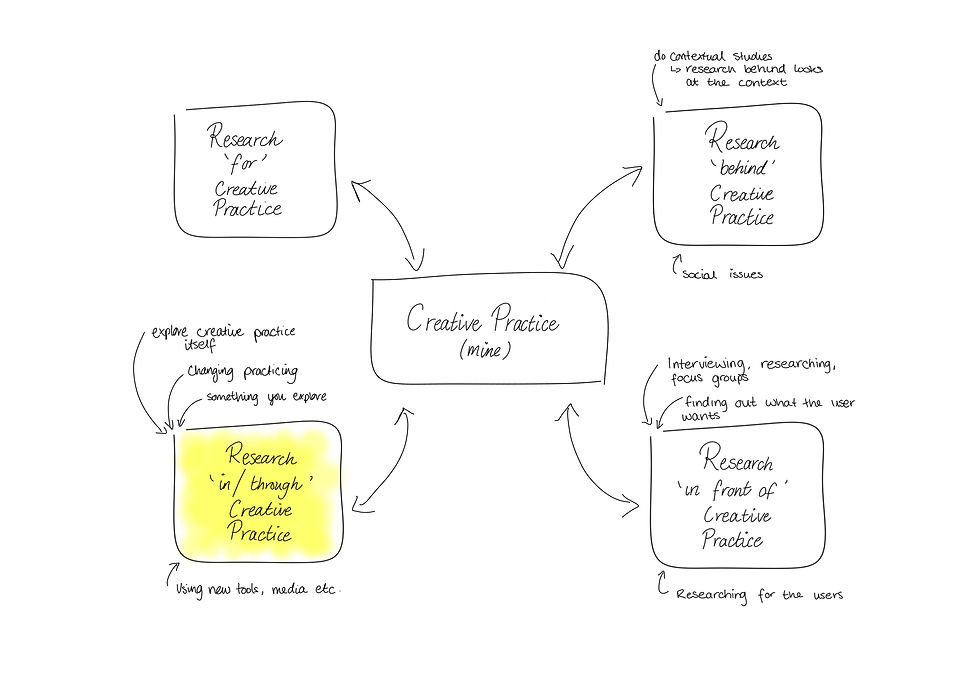
Research 'in/ through' creative practice explores the creative practice itself. It could be that you're changing practices, or is a new route you want to explore, it could be the use of new tools, materials, processes etc.


The theory of the creative practice Is the response to a particular event, looking at social ideas and ideals. It is the conscious knowledge of something. This will need to be backed up by evidence rather then saying 'I think' or 'I read somewhere'.


Insights into/ derived from ones specific practice, allow me to consider how I think and feel, as well as reflecting upon my creative practice. This allows me to look at the materials, tools etc. to gain an understanding of which ones work for my specific design practice.


General - I know I prefer to work in the evening/ at night however I'm not specifically bound to only working at this time. I also know that there are certain parts of my design practice that I like to be alone so I can research and think clearly without background noise. However, I also know there are times where it is beneficial to me to work within a group setting to help bounce ideas around and talk to others when we might be stuck and need more inspiration/ a different perspective.


Materials - I know I like to work physically with different medias rather than using digital media. Mostly this is two-dimensional, using paint, biro or ink which I can then scan into photoshop to finish up.


Tools - I like to use online sources to research and gain an understanding for the projects I am doing, I also use mind maps as tools to help me get all the information down on paper so that I can see it all laid out and can go back to it for future reference. I think for my design practice it will be very important to expand my skills in the adobe suite.


Process - I use the same basic process for all my projects, with flexibility in them to move steps around or add in more if the project requires it. The first step will include mind mapping out my ideas so can see exactly what's going on in my brain. I then will research into the project to come up with a design brief - this may be a brief I came up with on my own, or one I have created with a client, the design brief could also be a set brief from a client. After the brief is set I can go about researching the different topics and issues relating to the brief, as these give me inspiration I will thumbnail my ideas. The research will continue on throughout the project. Thumbnailing, developing, prototyping, testing and redeveloping will all be key features within the process of my design practice.

MA Design Blog

bottom of page