top of page

Dartington Crystal is located in North Devon and is one of the only fully working glass factories in the UK. What makes it unique is that you can visit the factory to get an understanding of the glass making process from the first stages of production to the shop shelves.

It has been beneficial to my project to learn how they make differently shaped glasses and the processes needed to make a new shape. It was also interesting to find out what finishing techniques they can use on different glasses and bottles.

Looking at how much work goes into the creation of each product gives a newfound respect for the employees at every step of the production; from those working in the (very Hot) glass moulding and blowing warehouse - to those sandblasting - and those quality checking and packaging. Each role in the production is vital to the creation of high-quality glass products.

ree

The glass is heated up in the furnaces until it is hot enough to manipulate, then it is hand blown to the correct size to fit in the mould - where it is blown to the shape of the mould. The glasses are put in this rotatory machine (photo below) to heat the tops, removing the sharpness of the edge so they are safe to drink from.

ree

This blue bottle is one of the finished products produced by Dartington Crystal that really stood out to me. The detailed gold work stands out beautifully against the rich blue of the bottle. This is highlighted by the bright lighting!

ree

As well as creating all the glasswork, Dartington Crystal produces the packaging for their products. You can see that thought has gone into the packaging design to show the unique process of their products and that it has been tailored to the places they are selling to and their different target audiences.

ree


ree

Above is the first light that I bought to go underneath the bottles. The reason I bought this light is because you can change the colour and it is rechargeable, unlike most others on the market.

However when it was delivered I realised it's much smaller than I expected, this meant the gin bottles can fit on it but it is not a comfortable fit. I also realised that it is meant for a car cup holder and the benefit of this is it turns on from the car vibration and only when it is dark enough. This means when the light is on a stationary platform it turns itself off. There is the possibility for me to try soldering the vibration and light sensitivity components out of the circuit, however, with the fit not being great for the bottles I decided it would be better to go with a different type of lighting. What this light did tell me was that having a light shining up through the bottle works well and should highlight the etching on the bottle.

ree

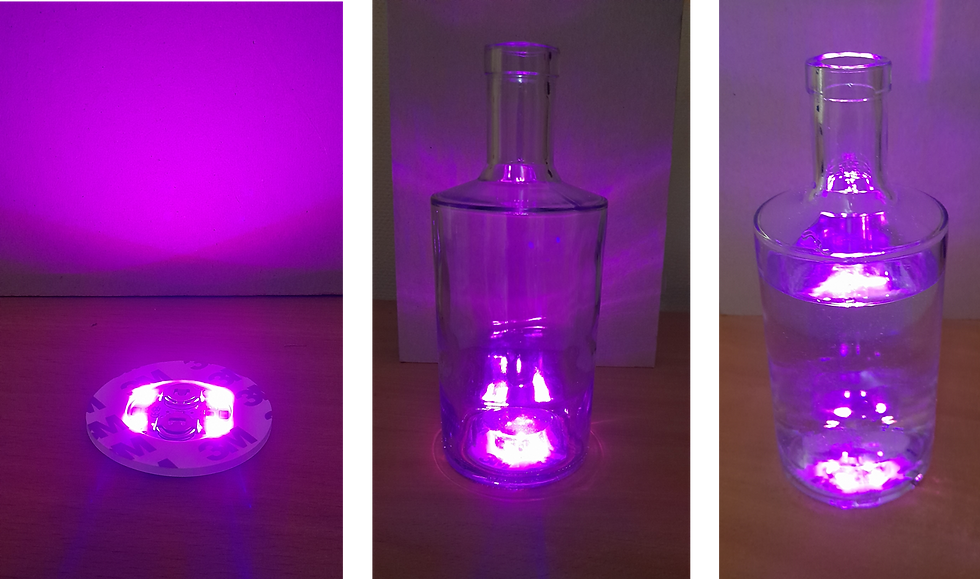
These new lights are each a single colour and therefore I had to work out what colours are needed before buying them. They fit much better with the glass than the previous ones and the lights are very bright, shining through the glass well. The images show the light on its own; the light under the glass; and the light under the glass with liquid in it. The reflections of the light in the water make it have a good effect and I can see this looking good on the shelves in a bar.

I decided to buy red, orange, blue and purple as these correlate with the flavours. I bought a spare one to see how it works as I wasn't sure if they were single-use. I was pleased to discover they have an on/off switch so are not single-use. However, as they are battery powered I am unsure how long the batteries will last before needing to be changed.

The below photo shows what the lights look like. They are thin and will be hidden well by the bottles placed on top so you can only see the light and not the plastic parts.

The next stage will be to etch onto the glass to see how the light looks with the etching. It will also be important to see how it looks with liquid in the glass.

ree


MA Design Blog

bottom of page